Composition With Red Blue and Yellow Piet Mondrian Ap Art Hisotry
Piet Mondrian is one of the most popular modern artists to appointment. He set the foundations for Abstract fine art equally we know it, exploring the relationships betwixt the abstract, spiritual, and fundamental in bones forms. We tin can easily spot a Mondrian artwork by its distinguishing lines, rectangles, and squares, depicted in primary colors. In this article, we explore 1 of Mondrian'southward afterwards oil paintings from effectually 1930, Composition with Red, Blue and Yellow.
Tabular array of Contents
- 1 Creative person Abstruse: Who Was Piet Mondrian?
- 2 Composition with Ruby, Blue and Xanthous (c. 1930) by Piet Mondrian in Context
- 2.1 Contextual Analysis: A Brief Socio-Historical Overview
- three Formal Analysis: A Brief Compositional Overview
- 3.1 Bailiwick Matter
- 3.2 Colour
- 3.3 Brushwork and Texture
- iv Piet Mondrian: Forever Composing
- five Oftentimes Asked Questions
- five.1 Who Painted Composition with Blood-red, Blue and Yellow (1930)?
- 5.2 From Which Art Movement Is Composition with Red, Blue and Yellow (1930)?
- 5.iii Where Is Mondrian's Composition with Red, Blue and Yellow Now?
- 5.four How Many Compositions Did Piet Mondrian Paint?
- 5.5 Did Mondrian Only Paint Color Blocks?
Creative person Abstruse: Who Was Piet Mondrian?
Piet Mondrian, originally named Pieter Cornelis Mondriaan, was born in 1872, March vii, and died in 1944, February 1. He was built-in in the city Amersfoort in the Netherlands and was exposed to art from youth and learned art from his male parent and uncle. Mondrian studied at the Majestic University of Visual Arts, otherwise known as the Rijksakademie van beeldende kunsten, located in Amsterdam from 1892.
Mondrian started painting landscapes and somewhen more abstruse artworks.
He was securely influenced by the Theosophical Society and people like Madame Blavatsky and Rudolf Steiner. Mondrian was the pioneer of the artistic theory chosen Neo-Plasticism, part of the De Stijl art way, which he co-founded with Theo van Doesburg. In 1911/1912 he relocated to Paris, where he was influenced by the fine art of Cubism and artists like Pablo Picasso. He also lived in London and eventually relocated to New York in 1940, where he stayed for the residual of his life. In 1944 he died of pneumonia.
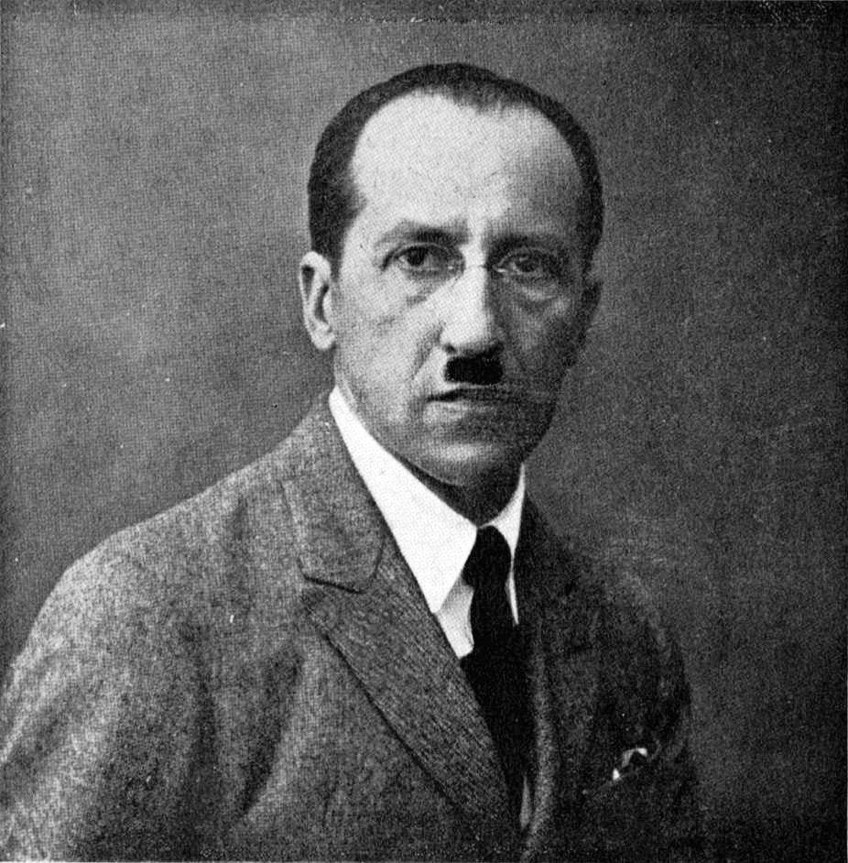 A photograph of Piet Mondrian from De Stijl, vol. v, nr. 12 (December 1922): p. 179.;Anonymous (photographer), Public domain, via Wikimedia Eatables
Composition with Cherry-red, Blueish and Yellow (c. 1930) past Piet Mondrian in Context
Piet Mondrian wrote, "I wish to approach truth every bit closely as is possible, and therefore I abstruse everything until I arrive at the fundamental quality of objects". This is at the center of the evolution of Mondrian's compositions. His later Composition with Red, Blue and Yellow (c. 1930) is just i example, which we will look at in more than detail beneath.
We will get-go provide a cursory contextual analysis about what underpins Mondrian'due south artistic and theoretical approach, followed by a formal analysis exploring Mondrian's stylistic approach.
| Creative person | Piet Mondrian |
| Date Painted | c. 1930 |
| Medium | Oil on canvas |
| Genre | Abstruse fine art |
| Period / Movement | De Stijl and Neo-Plasticism |
| Dimensions | 59.v x 59.v centimeters |
| Series / Versions | This painting is similar to a previous limerick done in 1929 |
| Where Is Information technology Housed? | Kunsthaus Zürich |
| What Information technology Is Worth | Estimated worth is in the millions of dollars |
Contextual Analysis: A Brief Socio-Historical Overview
For us to ameliorate empathize Piet Mondrian's artistic approach, otherwise referred to as "aesthetic theory" and the underpinnings of Composition with Red, Blue and Yellow, it is of import to first discuss the tenets of the art style called De Stijl and Neo-Plasticism, of which he was a pioneer aslope Theo van Doesburg. The two artists pioneered the motility chosen De Stijl, which means "The Manner".
The Dutch movement began around 1917, including other artists like J.J.P. Oud, Robert van 't Hoff, Bart van der Leck, Vilmos Huszár, and others.
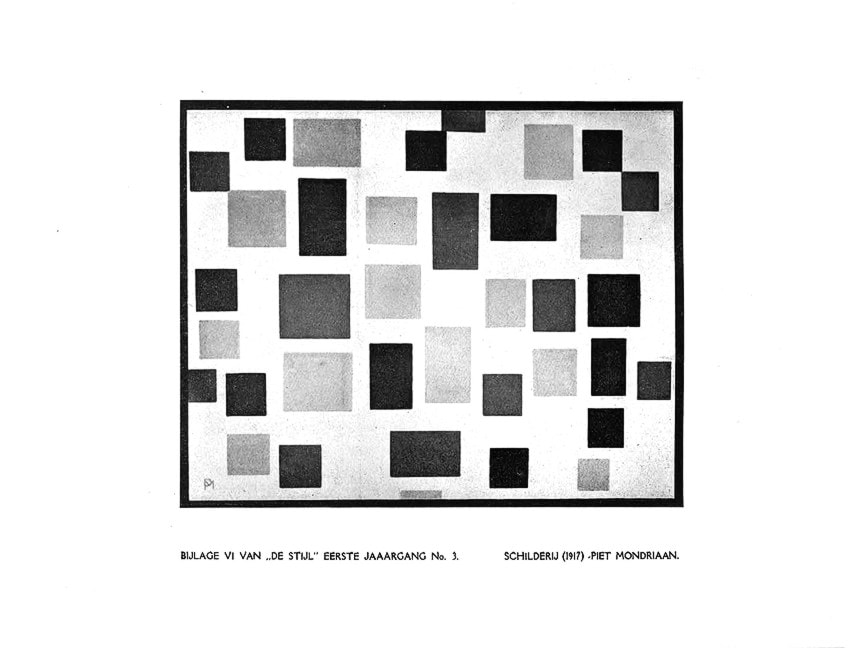 A page from De Stijl, jr. 1, nr. iii, annex 6, with an artwork past Piet Mondrian;Piet Mondrian, Public domain, via Wikimedia Commons
The art motility had an art journal titled De Stijl, which outlined the group's artistic theories and approaches. Some of the inspirations and influences for its evolution came from M.H.J. Schoenmaeker'due south publications effectually mathematical theories, namely, Het nieuwe wereldbeeld, or "The New Image of the Earth" (1915) and Beginselen der beeldende wiskunde, or "Principles of Plastic Mathematics" (1916).
The group was likewise influenced by the spiritual tenets of the Dutch Theosophical Society, of which Mondrian was also a member. The theories of the famous Theosophist Helena Petrovna Blavatsky, unremarkably called Madame Blavatsky were also applied.
The underpinning theory of De Stijl explored the concept that Mondrian developed from these various influences mentioned above, it was chosen Neo-Plasticism. He also wrote nigh in his essay titled Neo-Plasticism in Pictorial Art, in Dutch "De Nieuwe Beelding in de schilderkunst", which was published in the De Stijl journal.
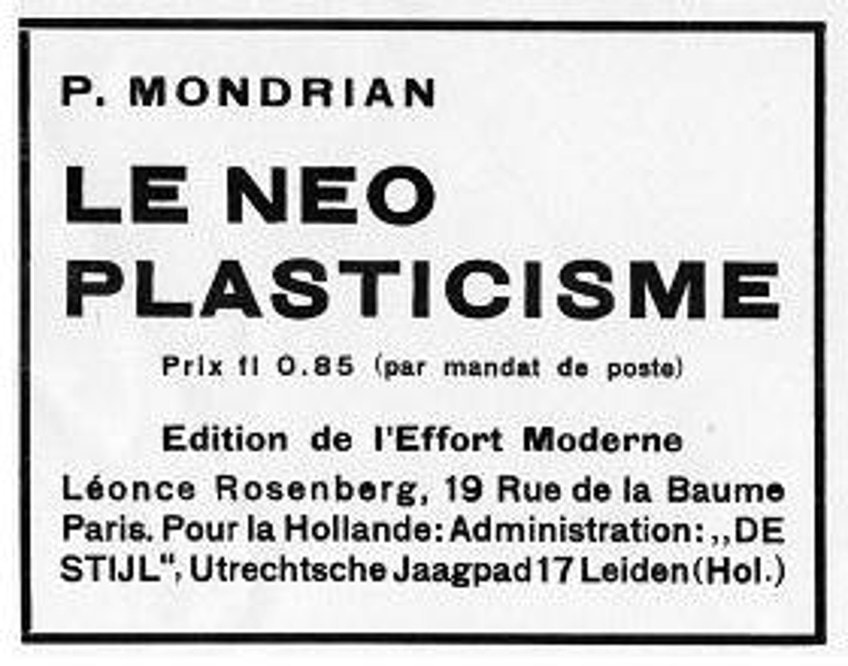 Advertisement of Mondrian'southward booklet Le Neo-Plasticisme from De Stijl (1924); The original uploader was Vincent Steenberg at Dutch Wikipedia., Public domain, via Wikimedia Commons
Neo-Plasticism embraced a new blazon of art, i that would be expressed through abstraction. This abstraction was to exist composed out of the ideas of harmony, order, and the fundamental nuts of the universe expressed through basic forms like directly lines (horizontal and vertical), cubic shapes, and primary colors, as well as white and black.
Neo-Plasticism was about the reduction of art, "reducing" fine art to these fundamental elements.
The artists explained that "As a pure representation of the human mind, art will express itself in an aesthetically purified, that is to say, abstract course…this new plastic idea will ignore the particulars of appearance, that is to say, natural course and color. On the contrary, it should discover its expression in the abstraction of form and color, that is to say, in the direct line and the clearly defined chief color".
When referring to plastic fine art, it simply refers to dissimilar types of fine art that can be "molded" especially with regards to 3-dimensionality, for example, sculpture. However, in the case of the De Stijl movement, it included a wide range of art modalities similar painting, sculpture, compages, too equally interior designing. The latter nosotros see executed past Gerrit Rietveld's The Cherry-red and Blue Chair (1923) and the Rietveld Schröder House (1924).
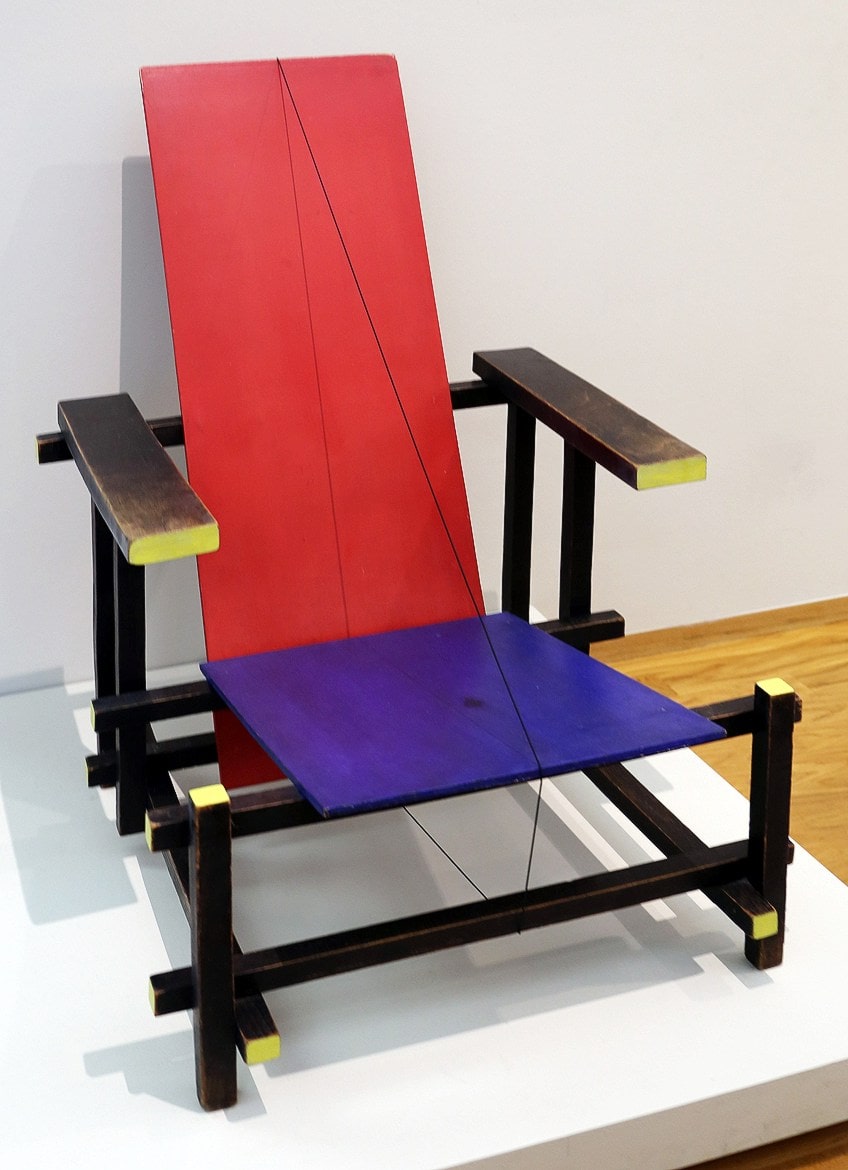 Gerrit Rietveld's The Scarlet and Blueish Chair (1923) in the Gemeentemuseum Den Haag;Sailko, CC By 3.0, via Wikimedia Commons
Formal Assay: A Brief Compositional Overview
While nosotros accept a basic understanding of the De Stijl movement's ideologies and creative theories, let u.s.a. look closer at one of the Piet Mondrian paintings. This is an exemplary artwork providing a visual representation of all the bones elements of art that ultimately communicates the essence, or harmony, inherent in the universe.
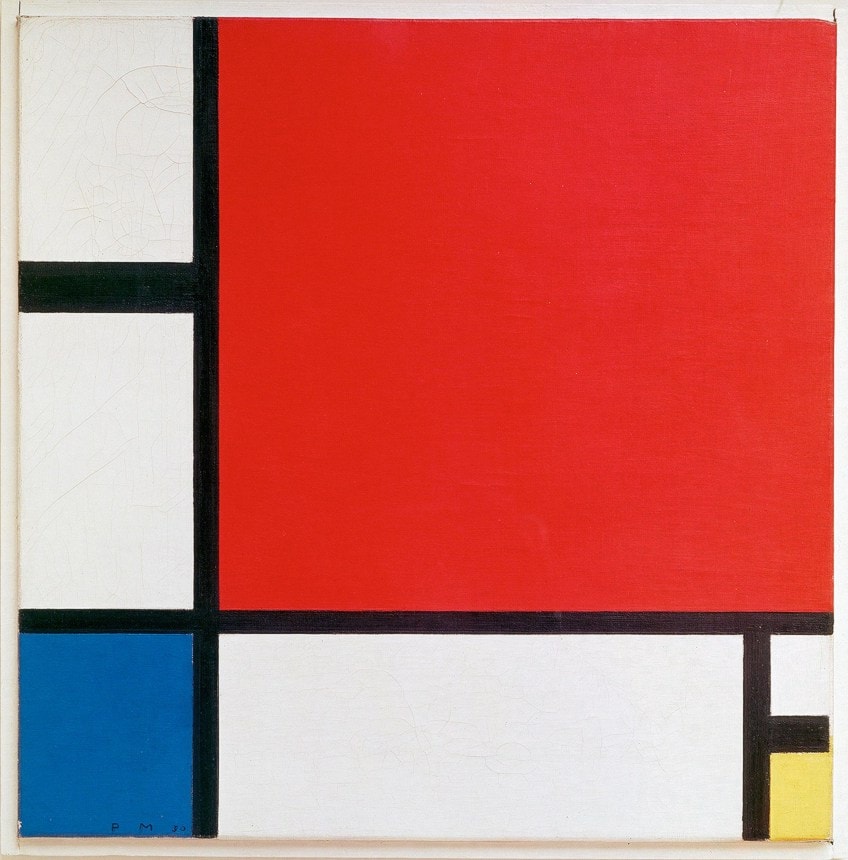 Limerick with Red, Blue, and Xanthous (c. 1930) past Piet Mondrian;Piet Mondrian, Public domain, via Wikimedia Eatables
Discipline Matter
In Composition with Red, Blue and Yellow, Piet Mondrian introduces a foursquare limerick within a square frame. It is composed of seven square and rectangular shapes in unlike sizes and colors divided past thick black outlines.
Starting in the top left corner, there is a white rectangle, followed by another white rectangle beneath it.
Below this is a blue foursquare in the lower-left corner. Next to the bluish square is a longer white rectangle that extends to two small squares on top of one another in the bottom right corner. The pocket-sized foursquare on summit is white and below it is a small yellow foursquare.
Above these, and what composes most of the composition, is a large red square on the right-paw side. This square almost pushes the other squares to the sides of the frame. What makes this composition unique is that all the squares and rectangles appear to proceed across the frame, where we cannot view information technology.
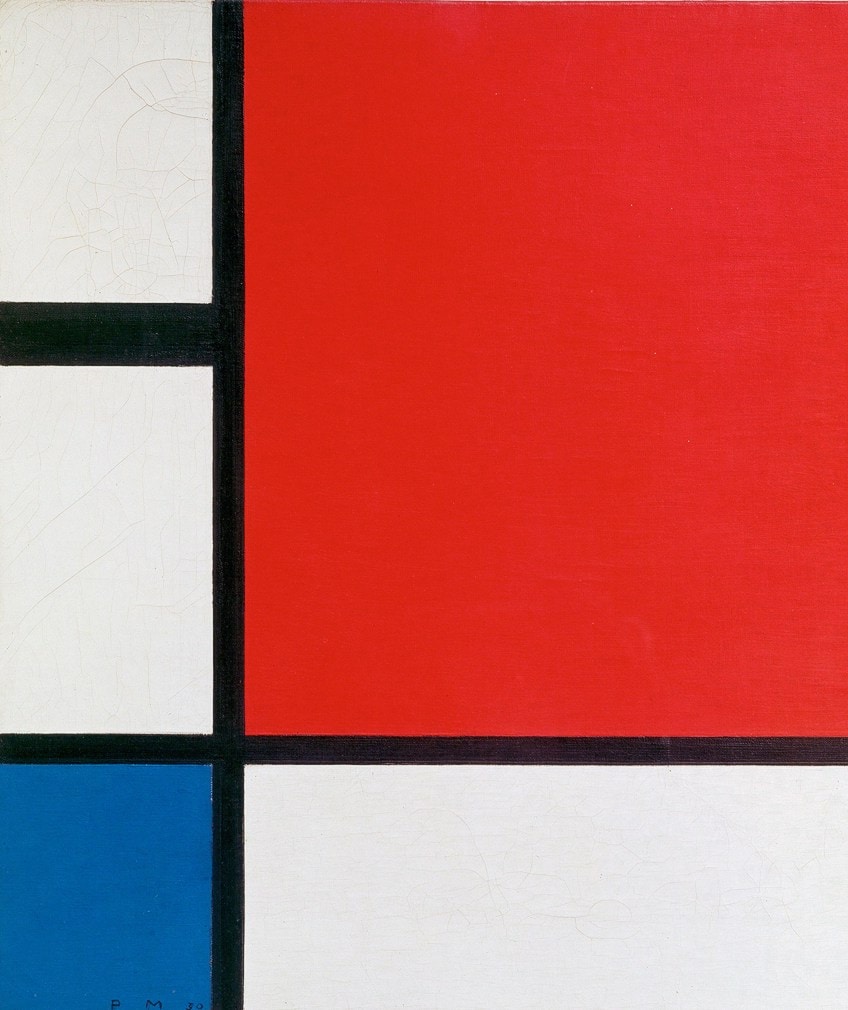 A close-upwards of Composition with Ruddy, Blue, and Yellow (c. 1930) past Piet Mondrian;Piet Mondrian, Public domain, via Wikimedia Commons
There are too no outlines forth the frame'southward edge to suggest that these shapes terminate. Additionally, if we look at the black lines, these as well extend beyond the sail visible to u.s.. However, this is also open to interpretation.
Looking at the black lines, these carve up the colored squares and rectangles from one another in vertical and horizontal arrangements.
There are three horizontal lines and two vertical lines. These also vary in thickness. The horizontal line in the upper left portion of the composition, between the ii white rectangles, is considerably thicker, doubled in thickness than the other lines. Similarly, then is the horizontal line between the two small squares in the bottom right corner.
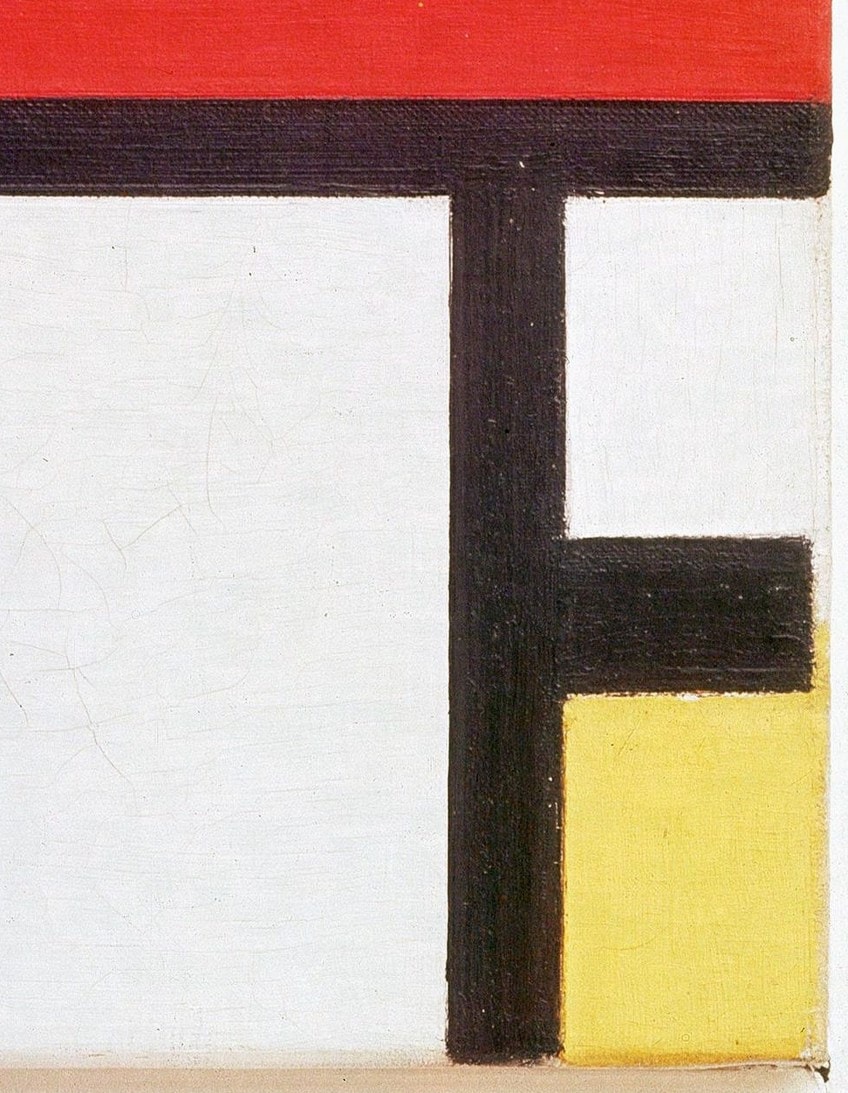 A detail of Composition with Red, Blue, and Yellowish (c. 1930) by Piet Mondrian;Piet Mondrian, Public domain, via Wikimedia Commons
It is also important to note that the black lines also get like the areas of color within them and are not mere outlines. At that place is too a slight gap between the horizontal line and the sail's frame in the lower right corner. It is as if Mondrian deliberately stopped just before the line could encounter the frame, which adds to the asymmetry and spatial ordering of the painting.
Colour
In Composition with Red, Blue and Xanthous, Piet Mondrian utilizes colors that announced to exist positioned asymmetrically. In other words, if we wait at the large crimson square to the right of the composition, it makes upwards almost two-thirds of the limerick and becomes a large visual focal point.
Yet, only contrary this red square is the smaller blue square in the lower-left corner, which almost balances the other while simultaneously creating an off-remainder.
Mondrian also utilized varying shades of colors. For example, there are slightly different shades of black in the lines, including the white areas of color. To ascertain the differences in colour, we demand to view the painting from up close.
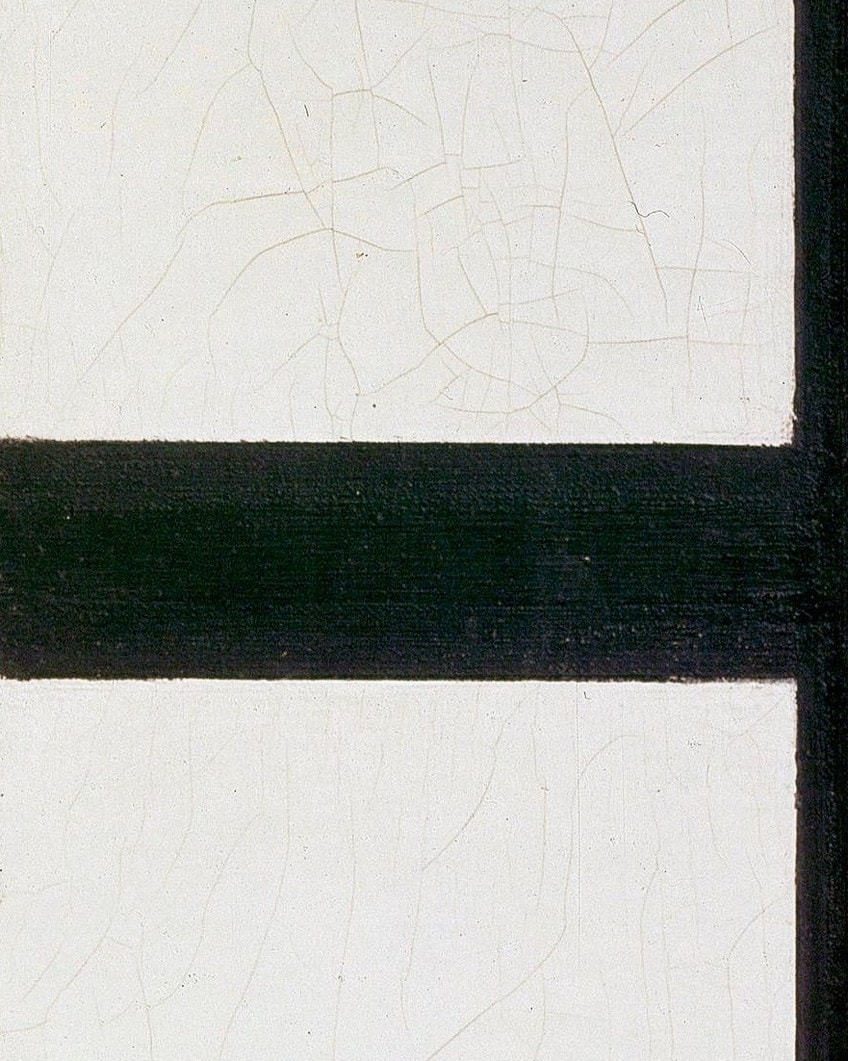 Color in Limerick with Red, Blue, and Xanthous (c. 1930) by Piet Mondrian;Piet Mondrian, Public domain, via Wikimedia Commons
Brushwork and Texture
Similarly, to understand and experience the textural qualities from the brushwork in this Mondrian artwork it is necessary to view it close-up. We will as well notice the brushstrokes and the meticulous precision with which Mondrian applied his paint; at that place are no overlaps of color and brushstrokes, and information technology appears as direct and clean as can be.
Brushwork in Limerick with Red, Blue, and Yellow (c. 1930) by Piet Mondrian;Piet Mondrian, Public domain, via Wikimedia Commons
Piet Mondrian: Forever Composing
Piet Mondrian has been and nonetheless is a name in art history that will never be forgotten. He was described as a "supreme" and "great" artist and influenced numerous other artists. His artworks, specially his abstract compositions, accept become icons for pop culture, everything from references in television series like Star Trek: The Next Generation (1987), Hustle (2004), and the musical serial titled The Partridge Family unit (1970 to 1974), including music album covers for bands like Silverchair and the White Stripes, every bit well as the contempo video game titled Mondrian Squares (2021).
Nosotros volition besides observe him in style, most notably The Mondrian Drove (1965) by the French manner designer, Yves Saint Laurent every bit well as see his name used in computer programming and coding; some say he was the forerunner of graphic blueprint because of the "filigree-fashion" of his paintings.
Mondrian certainly made a name for himself long after he died in 1944. Maybe we tin can depict Piet Mondrian's paintings as meticulous, thought-out, compositions that depict the fundamentals of the universe. These are non mere shapes and lines, yet simultaneously that is exactly what they are. Mondrian orchestrated a painted symphony on canvas and is forever composing through the art of others.
Frequently Asked Questions
Who Painted Composition with Red, Blue and Yellow (1930)?
Piet Mondrian, who was a Dutch artist and co-founder of the De Stijl art movement and Neo-Plasticism, painted Limerick with Cherry-red, Blue and Yellow in 1930. He besides produced numerous other paintings or so-called compositions; some were with similar titles to the above.
From Which Art Movement Is Composition with Red, Blue and Yellow (1930)?
Composition with Carmine, Blue and Yellow (1930) by Piet Mondrian was from the Dutch De Stijl art movement. The motion followed the ideologies that developed from Mondrian'south Neo-Plasticism art theories that sought to reduce art to its fundamental properties in terms of colors and shapes, which included primary colors, blacks, grays, and whites, and squares, rectangles, vertical and horizontal lines. At that place was an inherent search for the absolute in the abstract.
Where Is Mondrian'southward Limerick with Red, Blue and Yellow Now?
Piet Mondrian'south oil painting Composition with Cherry, Blue and Yellow (c. 1930) is housed at the Kunsthaus Zürich art museum located in Zürich in Switzerland. Other Piet Mondrian paintings are housed throughout the earth, some are at the Museum of Modern Art in New York, the Gemeentemuseum in the Hague, Netherlands, and others.
How Many Compositions Did Piet Mondrian Paint?
Piet Mondrian painted several abstract paintings that have titles starting with the word composition, namely Composition with Ruddy, Bluish and Yellowish 1930, Limerick No II, with Scarlet and Bluish (1929). Some other before Mondrian paintings include Composition with Color Planes (1917) and Composition with Large Red Airplane, Yellowish, Blackness, Gray, and Blue (1921).
Did Mondrian Just Pigment Colour Blocks?
Piet Mondrian also painted other abstract paintings that appeared filigree-like, but different from his famous compositions, for example, his later painting like Broadway Boogie-Woogie (1942 to 1943). Mondrian was inspired by New York City and Jazz music, which is where he lived when he painted this. It appears livelier with smaller squares and more than yellow instead of thick blackness outlines. During Mondrian's earlier periods he also painted landscapes or more "naturalistic" paintings, these were influenced past the post-Impressionistic manner of fine art. He was also influenced by the Cubist style of fine art axiomatic in his before painting, The Greyness Tree (1912).
harperalationever.blogspot.com
Source: https://artincontext.org/composition-with-red-blue-and-yellow-piet-mondrian/

Post a Comment for "Composition With Red Blue and Yellow Piet Mondrian Ap Art Hisotry"